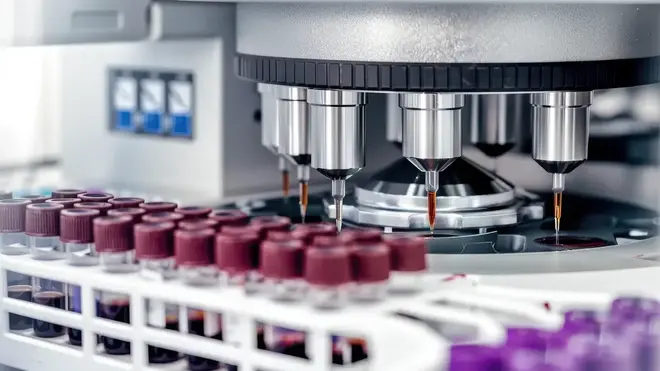
A testosterone blood test can be a single measurement or part of a broader hormone panel. Total testosterone may be ordered on its own, or alongside the proteins that carry it and the pituitary hormones involved in producing it.
Last reviewed: 12 October 2026
What a testosterone blood test measures
One blood collection can support several measurements, and where more than one is ordered they are read together. A broader panel may include:
- total testosterone, the usual starting measurement
- free testosterone, or the values used to calculate it
- SHBG, the main protein that binds testosterone
- LH and FSH, the pituitary hormones involved in production
- sometimes oestradiol, which men also produce in small amounts
Not every marker is ordered for every patient. What appears on your form depends on the question your doctor is trying to answer.
| Marker | What it is | Why it is measured |
|---|---|---|
| Total testosterone | All the testosterone in the sample, bound and unbound | The usual starting measurement |
| Free testosterone | The small fraction not attached to carrier proteins | It is the portion available to act on your tissues |
| SHBG | Sex hormone binding globulin, a carrier protein | When it is unusual, a total testosterone may not reflect what is available |
| LH and FSH | Hormones released by the pituitary gland | They help show whether a low result relates to the testes or to signalling above them |
| Oestradiol | An oestrogen that men also produce | It contributes to bone and sexual health and is read in clinical context |
Which of these appear on your report depends on what the doctor requested. A single total testosterone and a full hormone panel are different orders.
How the test is done, and why timing matters
It is an ordinary blood draw from a vein in your arm, usually at a collection centre. What makes it different from most tests is when the sample is taken.
Testosterone follows a daily rhythm, highest in the early morning and falling through the day. Healthdirect advises having the blood test early in the morning while you are fasting.
That is not a formality. A sample drawn in the afternoon, or after breakfast, can read lower than the same man would read at 8 am.
Do you need to fast?
A fasting morning sample is commonly recommended when a doctor is assessing possible androgen deficiency. Food can acutely reduce total testosterone, which is the reason behind that request.
It is not a universal requirement for every testosterone test. Follow the instructions on your request form or from the collection centre, because other markers on the same form may have their own preparation.
Why a low result is usually repeated
Testosterone varies across the day and between days, so one low reading is not enough to confirm a consistently low level.
The RACGP advises that samples be taken close to 8 am, that food can reduce total testosterone acutely, and that repeated fasting morning measurements are needed to confirm a low result.
In practice, a low first result generally leads to another fasting morning sample on a different day. If the low result is confirmed, LH, FSH and other tests may help the doctor investigate the cause.
How your result is read
Your report prints a reference interval beside each result. It shows where most results from a healthy comparison group fall, and your figure is read against it.
Two consequences follow. Some healthy men sit outside that range by definition, and a result within the range does not on its own explain symptoms, so it has to be read in clinical context.
The interval is usually the middle 95 per cent of results measured in a well defined healthy population. Intervals also differ between laboratories, because methods and instruments differ.
Comparing your number against a range you found online, or against a friend's result from another lab, is a common way to reach the wrong conclusion.
Why there is no single normal number
You will find charts online offering one figure, or a figure by age. We do not publish one, because the number on its own does not carry the meaning people expect it to.
What a result means depends on the laboratory's own interval, when the sample was taken, whether you were fasting, your age and health history, what the other markers show, and whether your symptoms fit. Two men with the same figure can need different answers.
What else can move a testosterone result
Timing is an important avoidable variable, but it is not the only influence. A result may be affected by short-term illness, longer-term health conditions, medicines and other factors.
Healthdirect notes that low testosterone can be caused by problems with the testes or the pituitary gland, obesity, some health conditions or ageing. The RACGP adds that levels are commonly lowered in men with metabolic syndrome, type 2 diabetes, obesity, depression, obstructive sleep apnoea or chronic kidney disease, that alcohol excess is a recognised cause, and that glucocorticoid and opioid medicines reduce testosterone.
This is part of why a low result is repeated. Another properly timed sample helps show whether the low level is persistent.
Exercise can also shift the number, because a hard session raises testosterone for a short time. We explain how training affects testosterone in a separate guide.
What happens after the test
Your results go to the doctor who ordered them, and they are read against your symptoms, your history and any medicines you take. The assessment checklist published by Healthy Male covers exactly that kind of history, from previous testicular surgery to coexistent illness.
We cover how long blood test results take and what happens when they arrive in a companion article.
From there the usual paths are reassurance, a repeat test to confirm the result, investigating contributing health factors, or discussing further assessment with the doctor. There is no obligation to start treatment to have the conversation.
If the symptoms came first and the numbers are the part you are checking, it is worth reading about low testosterone symptoms alongside your result.

Frequently asked questions
How to test testosterone levels
A doctor arranges a blood test.
Testosterone may be ordered on its own or alongside other hormones, depending on what the doctor is investigating. Healthdirect notes that the doctor will also consider your history and examination rather than relying on the number alone.
What time of day should the test be taken?
Early morning, close to 8 am, because testosterone is highest then and falls through the day. An afternoon sample can read low simply because of when it was taken.
Why has my doctor asked for a second test?
A low total testosterone result is generally repeated using another fasting morning sample, because one reading is not enough to confirm a consistently low level. If the low result is confirmed, LH, FSH and other tests may help the doctor investigate the cause.
What is the difference between total and free testosterone?
Total testosterone includes the testosterone in the sample that is bound and unbound. Free testosterone is the small unbound fraction.
SHBG affects how much testosterone is bound, so when total testosterone is borderline or SHBG may be altered, the doctor may use SHBG and other values to help assess calculated free testosterone.
Can I use a result from another laboratory?
Bring it, because a previous result is useful context for a doctor. Just do not compare the figures directly, since reference intervals and methods differ between laboratories.
Where to go from here
A testosterone blood test is a measurement, not a decision. Done at the right time, read with the other markers and confirmed when it matters, it tells you something useful about how your body is working.
If you want that result reviewed properly and want to understand what it means for you, that is what our low testosterone assessment is for. You can also see the full range of treatments we offer.